Eight operators, four published fields each
Sites like Stake: eight alternatives, counted rather than ranked
Every list of sites like Stake ends up ordering brands by the size of a welcome offer. This one orders them by how much each operator puts in print: an active permit in the issuing register, a verification clause carrying a number, a published list of barred territories, and a counted figure for the cashier or the lobby. Four fields, one point each, eight casinos like Stake. Two more names are missing on purpose, and the reason is printed below.
Sites like Stake: the short answer
Stake.com is a crypto-currency casino and sportsbook with one balance across both surfaces, a set of in-house games, a loyalty scheme paid back in percentages, and one of the shortest published territory lists in this whole index. That combination is what people are asking for when they type sites like Stake, and it is also why the search is harder than it looks: the brand being replaced publishes more about itself than most of the brands offered as replacements.
So this page does not rank. It counts. Each of the eight casinos like Stake below is scored out of four on things the operator itself puts in print — an active permit that resolves in the issuing register, a verification clause carrying a clause number, a published list of barred territories, and a counted figure for the cashier or the lobby. A filled box is an answer the operator published. An empty box is a document we could not read. Nothing in the count is an opinion, and nobody writing this page holds an account with any operator named on it.
Eight casinos like Stake, scored on what each one publishes
Here is the listing. Eight operators, every one of them holding a permit that resolved as active in the Curaçao register between 26 August and 2 September 2026, ordered by how many of the four fields each one fills.
- 1
 Vaveour partnerLatcas B.V. · OGL/2024/1676/0905 · active in the Curaçao register3of 4 fields
The casino this site is paid to feature. It ties at the top rather than leading it: the territory list is the field it leaves empty.
- Documents
- at the operator’s discretion, clause 8.7
- Territory list
- unread
- Counted in print
- 90 values in the cashier, six of them headline tickers
- 2
 CloudbetHalcyon Super Holdings B.V. · OGL/2024/328/0599 · active in the Curaçao register3of 4 fields
Sport and esports as the main product. The shortest published territory list in this listing — two names.
- Documents
- clause 18.1.1
- Territory list
- two territories named
- Counted in print
- unread
- 3
 ShuffleNatural Nine B.V. · OGL/2024/1337/0628 · active in the Curaçao register3of 4 fields
The longest published territory list among the rows that keep an active permit: fifteen names, read live on 26 August 2026.
- Documents
- clause 4.1
- Territory list
- fifteen territories named
- Counted in print
- unread
- 4
 BetFuryUniverse B Games B.V. · OGL/2024/1494/0942 · active in the Curaçao register2of 4 fields
The widest lobby in this listing. The verification clause carries no number we could cite, and no territory list reached us.
- Documents
- unread
- Territory list
- unread
- Counted in print
- 73 studios counted in the lobby
- 5
 RoobetRaw Entertainment B.V. · OGL/2024/687/0427 · active in the Curaçao register2of 4 fields
A counted lobby and an active permit. Its own documents stayed unread, which is a weaker handle than a clause number.
- Documents
- unread
- Territory list
- unread
- Counted in print
- 64 studios counted in the lobby
- 6
 TrustDiceSatoshi Gaming Group N.V. · OGL/2024/664/0280 · active in the Curaçao register2of 4 fields
Provably fair originals beside the shelf. Counted lobby, active permit, nothing further readable on 26 August 2026.
- Documents
- unread
- Territory list
- unread
- Counted in print
- 43 studios counted in the lobby
- 7
 DuelbitsLiquid Entertainment N.V. · OGL/2024/1507/0838 · active in the Curaçao register1of 4 fields
The permit resolves in the register and the rest of the sheet stayed empty. An empty cell is a document we could not read.
- Documents
- unread
- Territory list
- unread
- Counted in print
- unread
- 8
 RollbitBull Gaming N.V. · OGL/2024/1260/0494 · active in the Curaçao register1of 4 fields
Originals and a sportsbook beside them. Permit active in the register; no clause number and no territory list reached us.
- Documents
- unread
- Territory list
- unread
- Counted in print
- unread
Eight casinos like Stake, each with a permit that resolved in the Curaçao register when we opened it. The count beside each name is how many of four fields the operator puts in print: an active permit in the register, a verification clause carrying a number, a published list of barred territories, and a counted figure for the cashier or the lobby. Stake itself fills three of the four. Two brands people ask about are absent from this listing on purpose — BC.Game and Bets.io, whose permits read Revoked in the same register on the same day. Every button opens the same place: the casino this site is paid to feature, not the operator printed beside it.
Three rows fill three of the four. Three fill two. Two fill one. Stake itself would sit in the first group — it publishes a territory list, a numbered verification clause and a permit that resolves, and leaves the cashier figure blank. That is the uncomfortable result this page prints rather than hides: measured on published fields, the site being left is not outclassed by the sites offered in its place.
Two names kept out of the listing, and why
Two brands turn up in almost every list of Stake alternatives written elsewhere, and neither is in the eight above.

One of the most-searched names in this corner of the trade, and the register entry behind it reads Revoked. It is named here and kept out of the listing above.

Publishes the longest territory list read for this site — 42 names — and carries a numbered verification clause. Neither fact survives a revoked permit, so it stays out of the listing too.
Both entries were read in the same register, on the same day, by the same method as the ten that came back Active. A revoked permit does not tell a reader what will happen to their balance, and this page does not pretend otherwise. What it does tell a reader is that the single field every one of the eight rows above fills — a permit that resolves as active when you type the number into the register — is a field these two do not fill. That is enough to keep them out of a listing built on exactly that measure, and not enough to justify leaving them unnamed.
What people actually mean by a Stake alternative
Before any count, it helps to be exact about the request. Five things come up again and again in the searches around this brand, and each is something an operator either publishes or does not.
- A crypto balance. The account is held and paid out in coins rather than in a local currency, which changes what a deposit and a withdrawal actually cost.
- Games written in-house. Stake is known for its own set of original titles that no aggregator sells, and readers want the same thing elsewhere.
- One wallet for casino and sportsbook. A single balance covers slots, live tables and sports bets, with no transfer between them.
- A loyalty scheme paid back in percentages. VIP tiers and rakeback, where the number that matters is what the percentage is taken of.
- Documents asked late. An account opened with an email, with identity checked when money moves rather than at sign-up.
Few websites like Stake carry all five at once, and that is worth knowing before a search starts. A brand can match the crypto balance and the single wallet and still ask for documents at sign-up; another can have games of its own and no sportsbook at all. Treat the five as a checklist rather than a definition: an online casino like Stake on one point is easy to find, and an online casino like Stake on all five is rare enough that the published fields usually decide between them anyway.
Each of those gets read the same way on this site: out of the operator's own pages, with the date attached. The crypto side is set out on crypto casinos like Stake, the in-house games on the originals page, the single wallet on betting sites like Stake, the loyalty arithmetic on VIP and rakeback and the document question on sites like Stake with no verification at signup.

An editorial illustration, not a screenshot. What a lobby looks like is the last thing this page compares: the terms behind it come first.
Stake.com and Stake.us are two products that share four letters
This needs saying early, because a large share of the traffic around the brand is American and lands on the wrong half of it.
Stake.com is the crypto-currency casino and sportsbook this site measures. Stake US is a separate American product, sold under different rules through a different company, and every figure on these pages refers to the first of the two. A reader searching stake us is usually not looking for a crypto casino at all, and the sections further down on sweepstakes and social casinos are there because that is where the American question actually leads. The full separation has a page of its own.
The measure: four fields, one point each, no weighting
Every listing of Stake alternatives needs a measure, and most of them use a star rating whose arithmetic is never shown. The measure here is four questions, worth one point each, applied to every row identically.
Does the permit resolve in the issuing register? Not “is a licence mentioned on the site” — does the number, typed into the register that issued it, come back with a company name and a live status. All eight rows above clear this, and two brands that a reader may have seen recommended do not.
Does the verification clause carry a number? A promise that documents are requested “in line with our policy” is not a clause. A numbered paragraph a reader can open and quote is. Three of the eight clear this.
Is there a published list of barred territories? The list itself, on the operator's own pages, naming countries. Two of the eight clear this, and one of them publishes the shortest such list in the whole index.
Is there a counted figure for the cashier or the lobby? A number somebody has actually counted — studios in the lobby, values on the cashier — rather than a marketing round number. Four of the eight clear this.
Add the four and you get a figure between one and four. It is not a quality score, and it does not predict whether a reader will enjoy the lobby. It measures one thing only: how much of itself the operator is willing to put in print, where a reader can check it. On a subject where almost every published comparison is paid for, that is the field most worth counting.
One name on this page is paid for its place
150% on the first of four deposits, up to 1.5 BTC with 100 free spins, and 4 BTC across the whole package. Read from the operator’s own promotions page on 24 August 2026. No wagering multiple is printed there, so none is stated here. 18+
Claim the first-deposit bonusThe eight rows, read one at a time
Vave fills three fields and is the casino this site is paid to feature, which the listing row says in as many words rather than burying. Its permit had to be found before anything could be checked against it — the operator names Curaçao and publishes no number — and the register returned OGL/2024/1676/0905, held by Latcas B.V., active since 19 May 2025, read on 2 September 2026. Identity documents can be demanded before any payout at the operator's discretion under clause 8.7, with fourteen days to supply them; anything above 50,000 USDT is paid in instalments under clause 8.8. The cashier carries around 90 values and the lobby some 2,500 games from 40 studios, checked on 25 August 2026, with a sportsbook running on the same account. Its territory list stays unread, so Vave appears in none of the country counts on this site, and that absence is ignorance on our side rather than a green light on its.
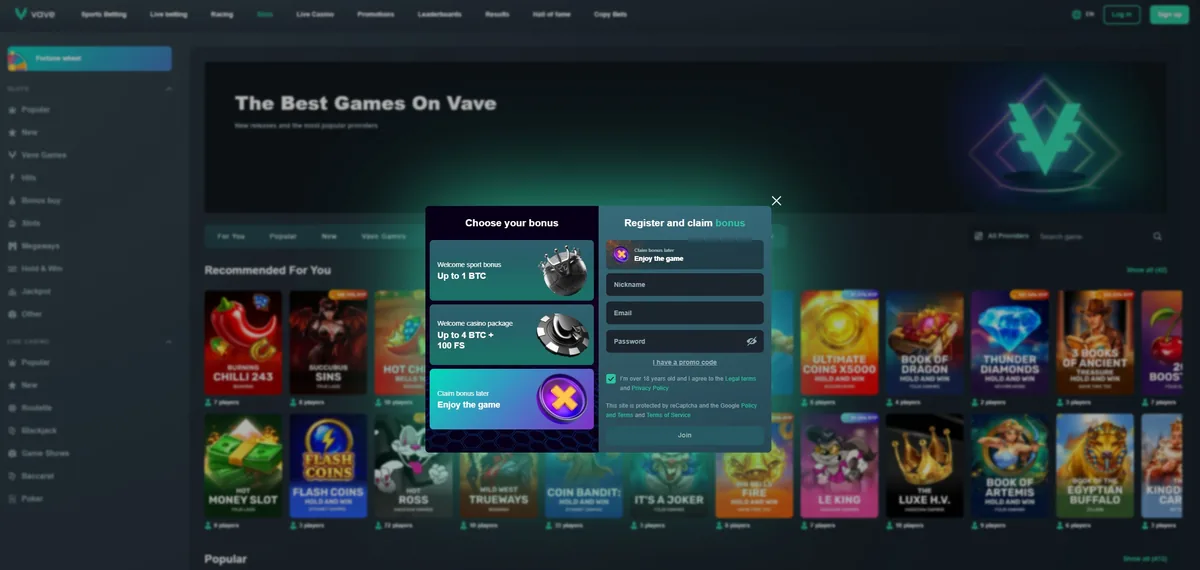
Vave, as a first-time visitor meets it: email and password, with identity held back until the cashier under clause 8.7.
Cloudbet fills three. Halcyon Super Holdings B.V. holds OGL/2024/328/0599, the verification clause is numbered 18.1.1 and reserves the right to re-verify a customer already verified once, and the published territory list names two countries — Australia and Belgium — which is the shortest list read anywhere in this index, Stake's own included. Sport and esports are the product rather than a tab beside the slots.
Shuffle fills three. Natural Nine B.V. holds OGL/2024/1337/0628, verification sits in clause 4.1, and the territory list names fifteen countries including Germany, Spain and the United Kingdom, read live from the operator's own terms on 26 August 2026. Its anti-money-laundering policy describes a risk-based threshold whose amount stays unpublished, which is worth knowing before treating the numbered clause as a full answer.
BetFury fills two. Universe B Games B.V. holds OGL/2024/1494/0942, and 73 studios were counted in the lobby on 26 August 2026 — the widest shelf in this listing. The verification clause carries no number we could cite and no territory list reached us, so both cells stay empty.
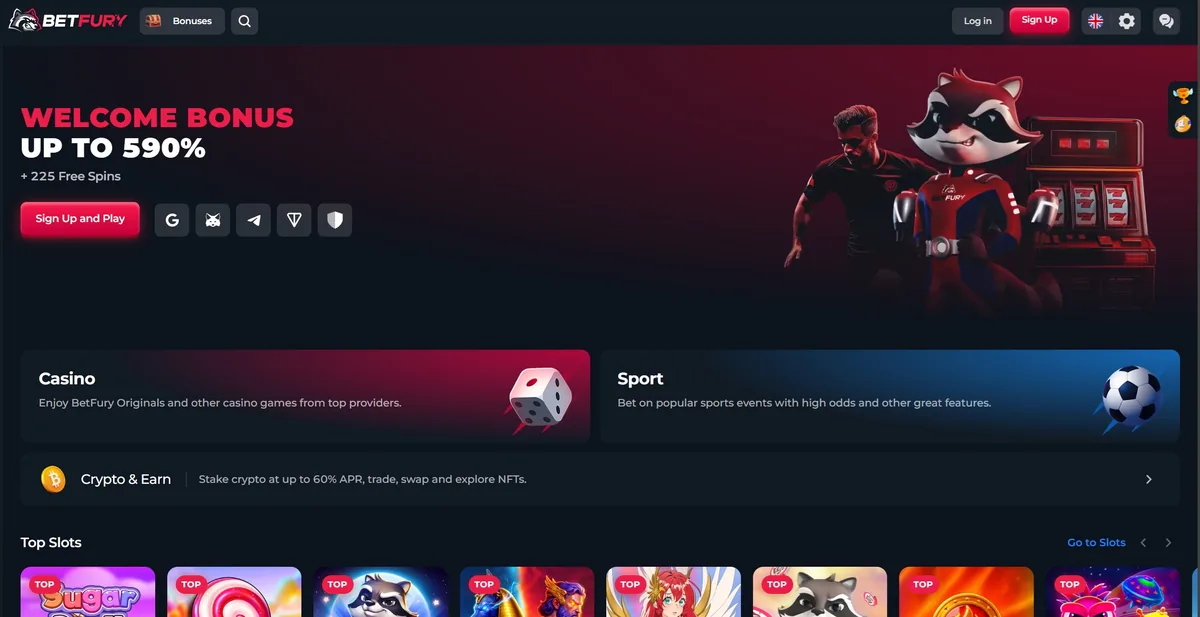
BetFury, one of the three rows with a studio count read from the operator’s own lobby: 73 studios on 26 August 2026.
Roobet fills two. Raw Entertainment B.V. holds OGL/2024/687/0427, active since 31 July 2024 for roobet.com, and 64 studios were counted in the lobby. Roobet also answers in the Anjouan register under ALSI-202507005, held by Ultima Spins Ltd — a second live permit and a second company, not a replacement for the first. Its own documents stayed unread here, which is a weaker handle than a clause number.
TrustDice fills two. Satoshi Gaming Group N.V. holds OGL/2024/664/0280, 43 studios were counted in the lobby, and provably fair originals sit beside the aggregated shelf, which is the closest thing in this listing to the reason people ask about Stake Originals in the first place.
Duelbits fills one. Liquid Entertainment N.V. holds OGL/2024/1507/0838, the permit resolves, and the rest of the sheet stayed empty. One filled box out of four is not an accusation; it is a record of how far the reading got.
Rollbit fills one. Bull Gaming N.V. holds OGL/2024/1260/0494, active since 23 May 2025 for rollbit.com. Originals and a sportsbook sit beside each other, no clause number and no territory list reached us, and until 4 September 2026 even the permit cell here was blank — a fault of this table rather than of the operator, because the cell used to be filled only from what a brand published about itself. The register had the answer for both Roobet and Rollbit the whole time.

An editorial illustration. Studio counts and in-house games are product questions, answered here only where the operator’s own lobby was read.
Sweepstakes casinos and social casinos: the American answer
Two phrases sit right next to sites like Stake in the same searches, and neither describes a crypto casino. A sweepstakes casino sells a virtual currency and gives a second, redeemable one away alongside it; a social casino sells a virtual currency that redeems for nothing at all. Both are large in the United States — the sweepstakes phrase alone measures tens of thousands of searches a month there — and both exist because 32 of the 38 territorial lists read for this site name the United States, the highest count of any country in the index.
That is the whole shape of the American question. A reader in the United States looking for casinos like Stake is not usually choosing between eight offshore brands; they are choosing between a different product category and nothing. This site measures offshore operators on their published documents and does not sell the American products, so what it can honestly offer an American reader is the count itself: 32 operators exclude the United States in their own terms, six published lists leave it unnamed, and 62 lists stay unread.
No KYC casinos: what the clause actually says
A large share of the demand around this subject uses the phrase no KYC casino, and almost every clause read for this site quietly contradicts it.
Stake.com reserves the right in clause 4.8 to request documents at any time, to establish identity and location, and to restrict service, payment or withdrawal until identity is sufficiently determined. Shuffle reserves the same right in clause 4.1. Cloudbet places it in clause 18.1.1 and reserves re-verification of a customer it has already verified once. Vave puts it in clause 8.7, at the operator's discretion, with fourteen days to comply. Not one of those is an operator that will never ask. They are operators that do not ask at sign-up, which is a different promise with a different failure mode: the request arrives at the withdrawal rather than at the door.
The honest version of the phrase is therefore “documents asked late”, and the field worth comparing is not whether a clause exists but whether it carries a threshold. Across the clauses read for this site, exactly one operator anywhere in the wider index prints a sum. The rest reserve the right and name no amount, which means the amount is whatever the operator decides on the day. That is set out clause by clause on sites like Stake with no verification at signup.
Crypto casinos like Stake: the balance and the two conversions
The crypto part of the request is the easiest of the five to satisfy and the hardest to compare, because the interesting numbers are the ones nobody prints. Every one of the eight holds balances in coins. What differs is how many, which, and what happens at the two edges — the conversion in and the conversion out.
Vave is the only row here with a counted cashier: around 90 values, six of them headline tickers, on 25 August 2026. For the other seven the coin lists stay unread on this site, so those cells stay empty rather than being filled from somebody else's review. A reader comparing best crypto casino options on coin support specifically will get further on the operators' own cashier pages than on any comparison table, this one included, and the crypto page explains which two costs the cashier list never shows.
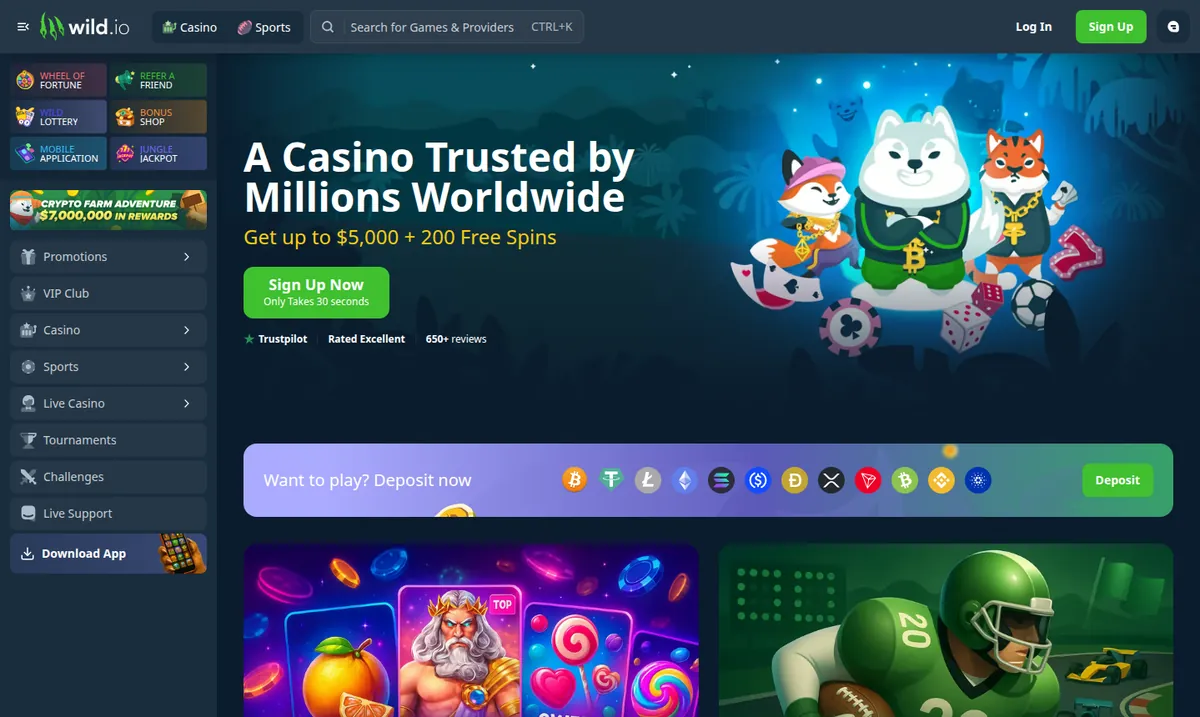
A crypto cashier as the operator shows it: the coins are named on the deposit screen itself, which is the only place such a list can be checked.
Stake Originals, Stake clones and Stake sister sites
Three related phrases, three different things, and conflating them is how most comparisons go wrong.
Stake Originals is a specific set of in-house titles — the dice, crash, plinko and mines family — written by the operator and sold by no aggregator. Asking which Stake alternatives have their own originals is a fair question with a concrete answer, and the answer is a capture of a lobby rather than a number in a table. TrustDice, Rollbit and BetFury all run house games of some kind; whether any of them is a satisfying substitute for a specific title is a matter of taste that no count settles.
A Stake clone usually means a site that copies the interface and the game set closely enough to feel like the same product. Copying an interface says nothing about who holds the permit or what the verification clause demands, which is why this page measures the documents and not the layout.
Stake sister sites means brands run by the same company. That one is answerable from the register: every row in the listing above carries the company named on its permit, and no two of the eight share a company. Anyone claiming a sister-site relationship between two of these brands is making a claim about corporate ownership, and the register entry is where it gets checked.
How many casinos like Stake refuse your country
The four-field count says how much an operator publishes. It says nothing about whether that operator will have you. For that there is a second count, built from a different set of documents: one hundred operators sit in the library behind this site, 38 of them publish a list of the countries they refuse, and each of those 38 lists was read at the operator's own address on 26 August 2026. Run one country through all 38 and a single figure comes out.
| country | operators that name it | published lists that leave it unnamed | lists unread |
|---|---|---|---|
| United States | 32 | 6 | 62 |
| United Kingdom | 29 | 9 | 62 |
| Netherlands | 27 | 11 | 62 |
| Germany | 12 | 26 | 62 |
| Ireland | 0 | 38 | 62 |
The three groups always sum to 100, which makes them easy to audit. The middle column is worded exactly as it is on purpose: a published list can be shorter than the practice behind it, the payment side decides separately from the terms, and an operator may amend the clause on any morning. Writing “accepts you” instead would be a promise, and this site has no standing to make one. The third column is ignorance, not a zero.
Europe holds 39 of the 122 countries and the highest regional average, 10.6 names per country. South America holds 10 countries and the lowest, 6.6. In between sit North America with the Caribbean at 10.2 across 14 countries, Oceania at 9.8 across 11, Asia at 8.7 across 33 and Africa at 8.1 across 15.
Regional averages flatten the thing worth seeing. Inside Europe the Netherlands is named 27 times, Spain 24 and France 23, while Italy, Finland and Switzerland are named once apiece and three further European countries not at all. A phrase like “a Stake alternative for Europe” therefore points at very little: two neighbours can differ by 26 names drawn from the same 38 lists. The European hub sets all thirty-nine side by side.
The seven lists that do most of the naming
A high count for a country usually means the same handful of very broad lists caught it, which is a different thing from an operator singling that country out.
Seven operators name more than 90 of the 122 countries each. Oshi Casino names 105. Mirax names 103, and 7Bit Casino 102. Bitkingz reaches 99, PlayAmo and Slotum 96 apiece, Bitdreams 95. Those seven alone account for most of what a mid-table country scores.
Below them the lists shorten fast. Winz.io names 40 of the 122. CryptoLeo and Nine Casino name 38 each, BitStarz 37. Then a long tail runs down to Cloudbet at 2 and three operators at 1 apiece. Two of the 38 lists name none of the 122 countries covered, because their entries fall entirely outside this set, so 36 lists do all the work in every count printed here.
So a country scoring 12 has usually been caught by the seven broad lists plus a few medium ones, and a country scoring 27 by the broad lists, the medium ones and several short ones as well. A short list naming your country is the signal worth weighing, because that operator sat down and wrote a specific clause about you.
Twelve rows on the same fields
The eight-row listing above is the shortlist. Behind it sits the fuller sheet: twelve operators, Stake included, on the fields that can be filled from documents with a date on them — the company named on the permit, the permit number with the register it was checked against, how many countries the operator names in its own terms, and the moment identity documents are demanded.
Four documents, read separately: the company named on the licence certificate in the issuing register, the permit number and where it was read, how many countries the operator excludes in its own terms, and when identity documents are demanded. The company column comes from the register in every row, never from an operator's own pages. The country count is the length of a list the operator published, not our estimate of where it will accept you. An empty cell means the document was not read — it is not a zero, and it is not a permission.
- VaveOur pick
-
- OperatorLatcas B.V.
- LicenceCuraçao Gaming Authority
- Countries barredlist not read
- Before ID checkcase by case
- Stake
-
- OperatorMedium Rare N.V.
- LicenceCuraçao Gaming Authority
- Countries barred1
- Before ID checkcase by case
- Shuffle
-
- OperatorNatural Nine B.V.
- LicenceCuraçao Gaming Authority
- Countries barred15
- Before ID checkcase by case
- BC.Game
-
- OperatorSmall House B.V.
- LicenceCuraçao Gaming Authority revoked
- Countries barredlist not read
- Before ID checknot published
- Roobet
-
- OperatorRaw Entertainment B.V.
- LicenceCuraçao Gaming Authority
- Countries barredlist not read
- Before ID checknot published
- Rollbit
-
- OperatorBull Gaming N.V.
- LicenceCuraçao Gaming Authority
- Countries barredlist not read
- Before ID checknot published
- Duelbits
-
- OperatorLiquid Entertainment N.V.
- LicenceCuraçao Gaming Authority
- Countries barredlist not read
- Before ID checknot published
- Bets.io
-
- OperatorBets Entertainment N.V.
- LicenceCuraçao Gaming Authority revoked
- Countries barred42
- Before ID checkcase by case
- Cloudbet
-
- OperatorHalcyon Super Holdings B.V.
- LicenceCuraçao Gaming Authority
- Countries barred2
- Before ID checkcase by case
- MyStake
-
- OperatorGTW B.V.
- LicenceCuraçao Gaming Authority
- Countries barredlist not read
- Before ID checknot published
- TrustDice
-
- OperatorSatoshi Gaming Group N.V.
- LicenceCuraçao Gaming Authority
- Countries barredlist not read
- Before ID checknot published
- BetFury
-
- OperatorUniverse B Games B.V.
- LicenceCuraçao Gaming Authority
- Countries barredlist not read
- Before ID checknot published
 Stake
StakeFour of the twelve publish a territorial list that has been read here. Stake.com names 1 country. Cloudbet names 2. Shuffle names 15. Bets.io names 42, the longest list in the table, taken from an archived copy of its terms — and carries a numbered verification clause besides, neither of which survives a revoked permit. The remaining eight rows leave that cell empty, and empty means unread.
All twelve carry a number in the current Curaçao Gaming Authority format, and every one was put to the issuing register — eleven on 26 August 2026, Vave on 2 September. Ten came back Active. Two came back Revoked. Three of the twelve print no number anywhere a reader can see it, and their numbers were found by searching the register on the domain instead: Vave, Roobet and Rollbit. The whole permit column is set out on gambling sites like Stake.
An editorial illustration. Live tables and slots sit behind the same account at most sites like Stake; which of them a reader can reach depends on the country count above.
Is Stake legit, and what that question is really asking
The phrase turns up constantly beside sites like Stake, and it usually bundles three separate questions that have three separate answers.
Does a real company stand behind it? That is a register question, and it is the one field every row in the listing above clears. A permit number that resolves to a named company with a live status is a fact about corporate existence, checkable in a minute, and it is the floor rather than the ceiling.
Will the money come back? No count on this page answers that, and any page that claims to is selling something. What can be compared is what each operator commits to in writing: a clause number for verification, an instalment ceiling, a stated window to supply documents. Vave publishes a 50,000 USDT instalment threshold in clause 8.8 and a fourteen-day document window in clause 8.7; that is more than most of the eight put in print, and it is still a term rather than a guarantee.
Will they have me? That is the country count, and it is the one question where the answer changes completely depending on where a reader sits.
Splitting the question three ways is not pedantry. It is the difference between a page that can be checked and a page that reassures.
Bonuses, promo codes and the number that is missing
Searches for a stake promo code or a stake bonus code run at several thousand a month, and a bonus is the one field this page refuses to score on, for a simple reason: a headline percentage without a wagering multiple is not a comparable number, and most of the operators here do not print the multiple.
The paid placement on this page is stated plainly rather than dressed as a verdict. Vave's four-deposit welcome package caps at 4 BTC plus 100 free spins, with 150% on the first deposit up to 1.5 BTC, taken from the operator's own promotions page captured on 24 August 2026. No wagering multiple is printed there, so none is stated here. That last sentence is the whole editorial position on bonuses: where the operator leaves the number out, this site leaves it out too rather than filling it in from a competitor's review.
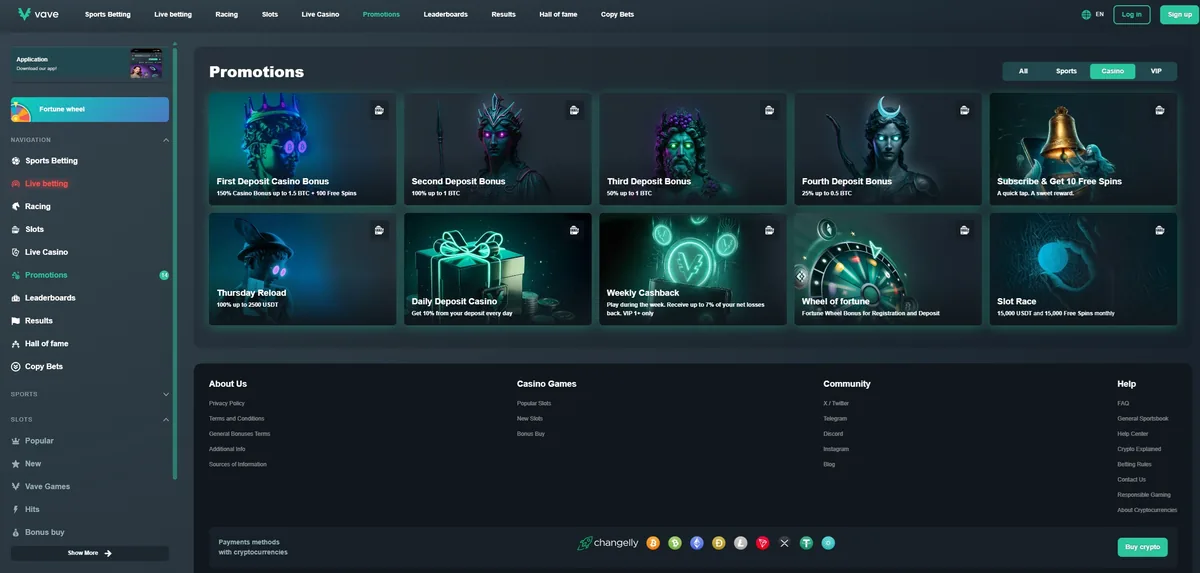
The welcome package is four deposits rather than one — 150%, then 100%, 50% and 25% — capped at 4 BTC plus 100 free spins across the set.
The loyalty side is more comparable and less discussed. A VIP scheme paying rakeback quotes a percentage, and the percentage is meaningless without its denominator — a percentage of wagers, of house edge, or of net losses are three different offers wearing the same number. Which denominator each scheme uses is on VIP and rakeback.
What this page does not claim
It does not claim any of the eight will accept a reader, pay a reader, or behave tomorrow the way its terms read today. It does not claim that four filled boxes are better than two in any sense beyond the literal one: more of the operator is in print. It does not report playing, because nobody writing it holds an account with any operator named here, and it does not report payout times, support experiences or withdrawal speeds for the same reason.
What it does claim is that every figure on it can be reproduced. Open the same register, type the same twelve numbers, read the same clause numbers on the same pages, and the counts come out the same. Where a document stayed shut, the cell is empty and says so. That is a narrower promise than most pages about sites like Stake make, and it is the only one worth making.
The count is reproducible. The taste is yours.
Open the same register entries and the same clause numbers and the counts above come out the same. What no count settles is which lobby you actually enjoy sitting in.
Play at the online casino